Login to contribute:
- your own travelogue
- your own pictures
- your own guestbook
- at no charge


Navigation:
Login to contribute:


My 18-day trip to Thailand with my parents, younger sister, and my girlfriend. We bussed from Bangkok to Kanchanburi, then back to Bangkok to fly to Surat Thani, travelling on to Khao Sok national park. Next we spent a day in Khao Lak before boarding a 3-day liveaboard dive/snorkelling trip in the Similan Islands. Next we bussed to Krabi and explored Phang-na bay. Finally, we flew back to Bangkok for shopping and the Songkran festival.
Travelogue-Specials:
|
|
|
sign the guestbook of this travelogue! |
The next morning we flew from Krabi back to the Bangkok airport, this time landing at the Don Muang airport. It's a bit closer to the city, but the airport taxi stand forced us to take 2 cars so it ended up costing almost 1000THB to get to our hotel in the Sukhumvit area. We had chosen the Atlanta based on some positive reviews in our guidebooks and because a family room only cost 2000BHT. The lobby area seemed very nice, with a antique style décor, but the rooms were not so wonderful. It's one thing to have old and barely functioning fixtures, but when my Dad wiped his finger through the dirty-looking sink basin, it was grey - they hadn't even bothered to clean properly. The tub was also dirty and cracked, and one wall had a row of cinderblocks - the kind that have holes to let in air from outside (and thus flying insects as well). We decided it was good enough for one night, and would seek a better hotel the next day.
My parents and sister went to visit a tailor shop which had been recommended as a good place to get a custom dress made. My sister had brought with her a series of diagrams of her dream dress, along with photos that illustrated various features that she wanted to include. Unfortunately, when the tailor saw the photos he refused to make the dress, saying he wouldn't steal someone else's design. More likely he was just trying to get them to agree to use one of his pre-made dress patterns. Meanwhile, my girlfriend and I went our own way and shopped the Siam Paragon and MBK (Mah Boon Krong) malls until most of the stores closed, about 8:00pm.
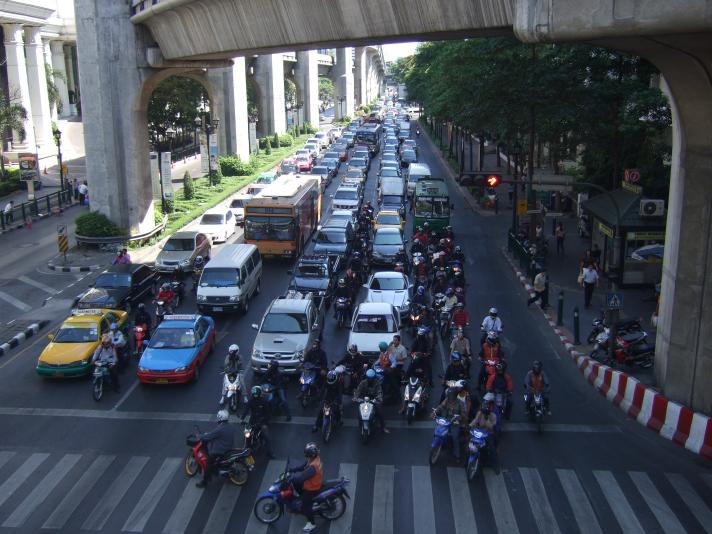
Phayathai Rd viewed from walkway above Ploenchit Rd.
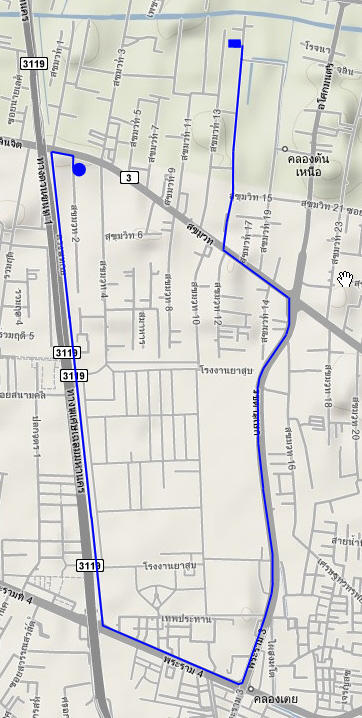
My Dad got up early to go online in search of a new hotel. He found a place nearby called the Star Suites Serviced Apartments, who had a 2-bedroom suite for only 2200BHT. My parents took a taxi to check it out, and upon returning they asked the driver to wait while they picked up our baggage. But when we came down, he was gone and the lady at the front desk said she paid him and demanded we repay her. We suspect that she chased him off to prevent us from leaving. Dad walked up the road to Sukhumvit to hail another taxi, but while we were loading the baggage the front desk woman spoke to him in Thai, and then he began refusing to take more than 3 of us. Realizing that the lady would chase away any other taxis that came near, we picked up our bags and walked down the street to the Marriott, where a doorman helped us get a metered taxi. However, the problem with metered taxis is that they will take you the long way - sometimes saying it's a shortcut, or in our case using bad traffic as an excuse.
Route taken by our taxi, starting at the circle
Kitchen in our 2-bedroom suite
Though Star Suites is a long ways down soi 15 (a soi is a small road), they offered a free tuk-tuk service to the nearest Skytrain or subway station. There were a bunch of tailor shops near the station, so we chose one and showed him the dress design. After much discussion, material selection, and bargaining, we finally had the dress creation underway. We all went to the Pratunam center for more shopping, but discovered that many of the shops had gone out of business. The girls explored what stores remained, while my Dad and I walked down to Pantip Plaza - a mall full of electronics - to buy him a new waterproof camera (see end of the Similan Islands chapter for the story of what happened to his last one). When we met back up again, my Mom, sister, and girlfriend were all getting massages that they enjoyed immensely. We shopped the Platinum Fashion Mall, and MBK, then ate supper and took a cab to the Suan-Lum Night Bazaar. There were all kinds of hand-made goods, clothing, jewelry, purses and wallets, paintings, wood carvings, etc.. There was even a stall selling glass coasters and other objects which have bamboo, lemongrass, or other things embedded inside the glass.
A stall at the Suan Lum night market
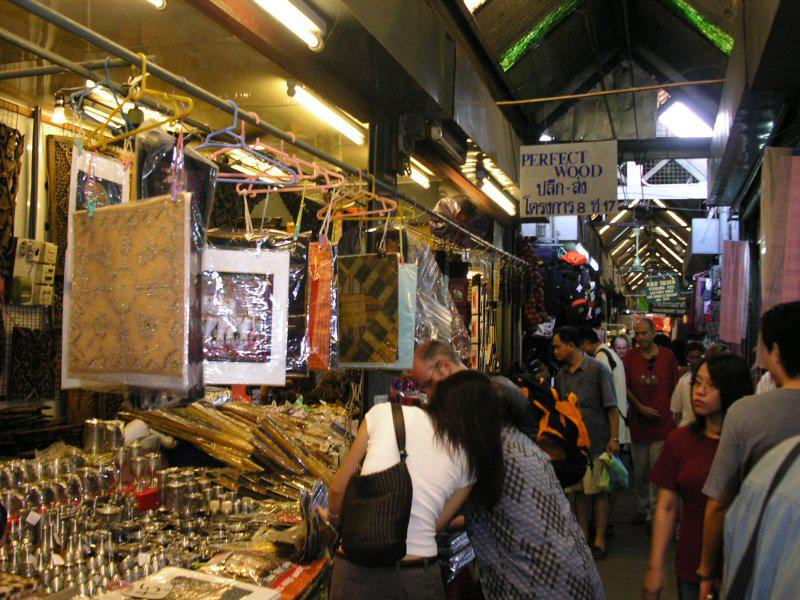
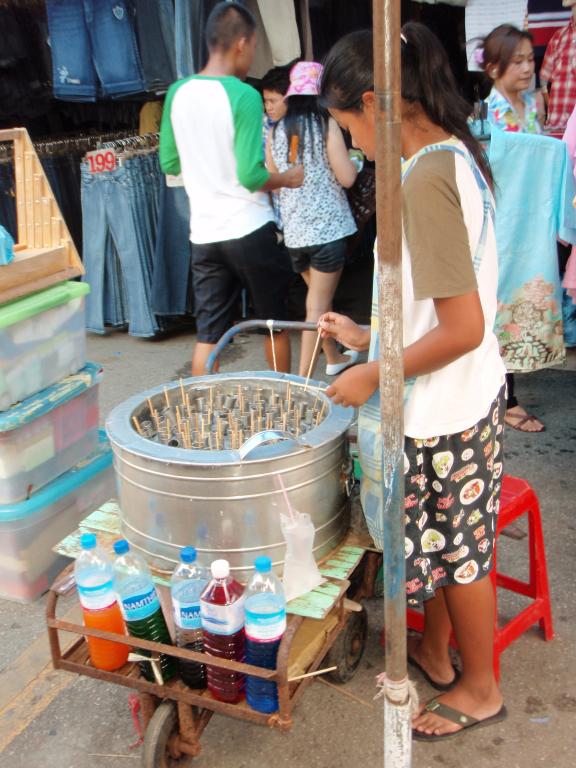
The next day had even more shopping in store for us, as it was now Saturday and the Chatuchak weekend market was open. The Skytrain goes all the way to the market, which is on the northern outskirts of Bangkok. Inside, it was very hot, somewhat crowded, and unfathomably huge. We wandered randomly through unending isles of stalls, doing our best to avoid the watergun toting Thais (that weekend also happened to be the Songkran festival, the Thai new year, where it is traditional to throw or squirt water at others). We ran into some tourists who had wisely purchased a map of the market from a bookstore, and were then able to locate the textiles area, where my girlfriend bought 3 silk scarves for 80THB each. Spread throughout the market were people selling a popsicle made from pouring pop or juice into an inverted metal tube, which is then placed in a large metal bucket full of ice and salt-water. These popsicles are wonderful when you're hot and thirsty, and they only cost 3THB! Still, the heat became too much so we headed for some air conditioning in the nearby JJ Mall.
Chatuchak market from above
Inside the market
We loved these "pop"sicles!
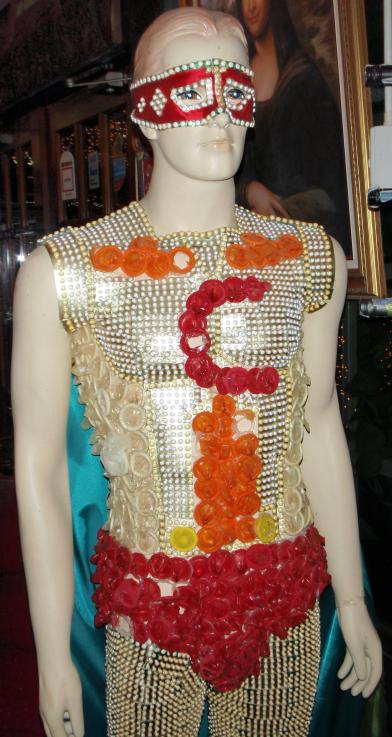
Unfortunately, we didn't have enough time to explore the rest of the market as my sister needed to return to the tailor for a fitting. In 24 hours they had already put together the basic shape of the dress, but there were several features that were either done wrong or hadn't been done yet. After a relaxing swim in the rooftop pool, we went out for dinner at a restaurant called Cabbages and Condoms, which has many decorations made out of condoms, and you are given condoms instead of dinner mints! And, all proceeds from the restaurant are used to fund the social development programs of the Population and Community Development Association. There was also 15-minute Thai foot massages available, so I decided to give it a try. It was my first ever foot massage, and though the Thai's can be a bit rough, it felt pretty good.
Captian Condom, in the Cabbages & Condoms restaurant
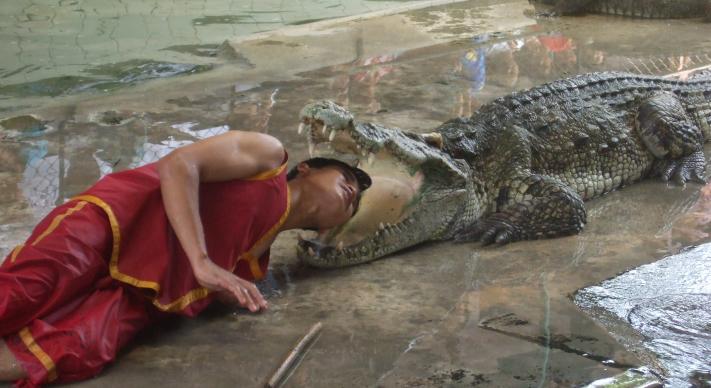
On my final day in Thailand, I finally got to see some elephants. We hired a taxi driver for the day to take us to the Samphran Elephant Grounds, and the nearby Rose Garden cultural show. We arrived just in time to catch the crocodile wrestling show, and though the program was in Thai, we still enjoyed the bravery of the two boys. They would grab one of the many crocs by the tail and drag it around into position. Then they'd pry its mouth open and tease it a bit, by prodding it with sticks. One of the more impressive stunts involved wetting down the ground, and then sliding head first along the slippery surface toward the gaping jaws of a huge crocodile. At the last moment before getting eaten, the boy would jump up and go over top of the croc! They also played with an large, older looking crocodile, by putting their hands and even their entire head inside its mouth.
Sticking a hand inside the crocodile's mouth
Now his whole head goes inside! Hope that croc is well fed, because if he gets hungry during the show...
There was an elephant show immediately afterwards, but our taxi driver told us there would be another one later in English. So we wandered around the grounds (a small zoo), looking at a few monkeys, rabbits, and the crocodile breeding pits. They also have some hanging orchid gardens, but only a few plants had any blooms. Next we shelled out 500THB each for me and my sister to get a 20 minute ride on an elephant. It was awesome to be riding on top of such a huge animal, but the highlight actually came at the end. They gave me some bananas to feed my elephant, and while doing so, the trainers brought over an even bigger elephant who gave me a big "hug". Basically, it wrapped its trunk around my waist, and then picked me up off the ground!
Riding an elephant with my sister
Elephant picking me up
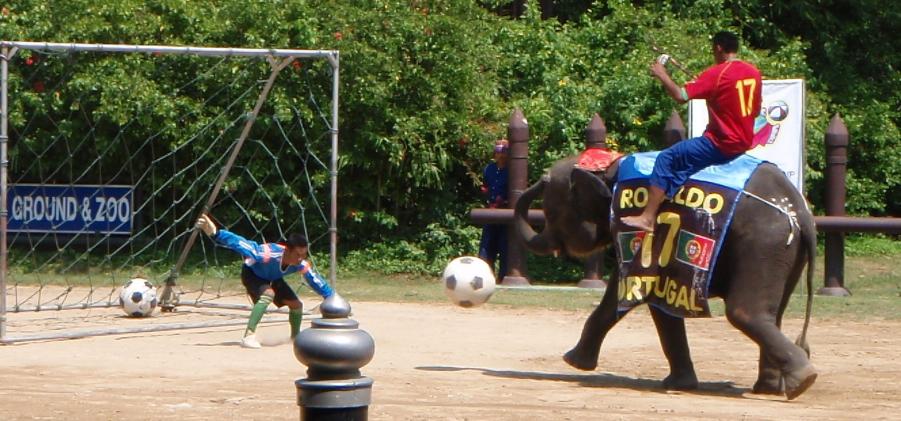
After a quick, cheap lunch, we headed over to the elephant show early to get good seats. First there was a magic show on a small portable stage, but the tricks were pretty bad - only children would be impressed. The elephant show was really good though, and included demonstrations of how they were used for logging, and how they hunted and captured an elephant from the back of another one. They performed a battle simulating how the ancient kings used to participate in combat from elephant-back, with authentic costumes for the riders and the elephants! There were even some pyrotechnics to simulate a cannon assault on a castle wall. Finally, there was the fun part of the show, where a team of elephants wearing the colors of various countries came out onto the field, and did tricks like dancing, picking up objects, and racing through a obstacle course. The best part was a soccer shootout: with a human goalie, the elephants line up and kick giant soccer balls at the net one at a time. Whenever an elephant scored, it would do a little victory dance!
Write a guestbook comment
| Boss | http://www.yahoo.com/ | |
|---|---|---|
| Gee whiz, and I thughot this would be hard to find out. | ||
| Luckie | http://www.yahoo.com/ | |
|---|---|---|
| And I was just wondrenig about that too! | ||
| Lucky | http://www.google.com/ | |
|---|---|---|
| At last, soemnoe comes up with the "right" answer! | ||
| Bruder | http://www.kiwata.com/images/film/index.html | |
|---|---|---|
|
The rise of European cinema was interrupted by the outbreak of World War I when the film industry in United States flourished with the rise of Hollywood, typified most prominently by the great innovative work of D. W. Griffith in The Birth of a Nation (1914) and Intolerance (1916). However in the 1920s, European filmmakers such http://www.kiwata.com/images/film/category1.html as Sergei Eisenstein, F. W. Murnau, and Fritz Lang, in many ways inspired by the meteoric war-time progress of film through Griffith, along with the contributions of Charles Chaplin, Buster Keaton and others, quickly caught up with American film-making and continued to further advance the medium. In the 1920s, new technology allowed filmmakers to attach to each film a soundtrack of speech, music and sound effects synchronized with the action on the screen. These sound films were initially distinguished by calling them "talking pictures", or talkies. The next major step in the development of cinema was the introduction of so-called "natural color", which meant color that was http://www.kiwata.com/images/film/category2.html photographically recorded from nature rather than being added to black-and-white prints by hand-coloring, stencil-coloring or other arbitrary procedures, although the earliest processes typically yielded colors which were far from "natural" in appearance. While the addition of sound quickly eclipsed silent film and theater musicians, color replaced black-and-white much more gradually. The pivotal innovation was the introduction of the three-strip version of the Technicolor process, which was first used for short subjects and for isolated sequences in a few feature-length films released in 1934, then for an entire feature film, Becky Sharp, in 1935. The expense of the process was daunting, but continued favorable public response and enhanced http://www.kiwata.com/images/film/category3.html box-office receipts increasingly justified the added cost. The number of films made in color slowly increased year after year. In the early 1950s, as the proliferation of black-and-white television started seriously depressing theater attendance in the US, the use of color was seen as one way of winning back audiences. It soon became the rule rather than the exception. Some important mainstream Hollywood films were still being made in black-and-white as late as the mid-1960s, but they marked the end of an era. Color television receivers had been available in the US since the mid-1950s, but at first they were very expensive http://www.kiwata.com/images/film/category4.html and few broadcasts were in color. During the 1960s, prices gradually came down, color broadcasts became common, and the sale of color television sets boomed. The strong preference of the general public for color was obvious. After the final flurry of black-and-white film releases in mid-decade, all major Hollywood studio film production was exclusively in color, with rare exceptions reluctantly made only at the insistence of "star" directors such as Peter Bogdanovich and Martin Scorsese. Since the decline of the studio system in the 1960s, the succeeding decades saw changes in the production and style of film. Various New Wave movements (including the French New Wave, Indian New Wave, Japanese New Wave and New Hollywood) and the rise of film school educated independent filmmakers were all part of the changes the medium http://www.kiwata.com/images/film/category5.html experienced in the latter half of the 20th century. Digital technology has been the driving force in change throughout the 1990s and into the 2000s.Film criticism is the analysis and evaluation of films. In general, these works can be divided into two categories: academic criticism by film scholars and journalistic film criticism that appears regularly in newspapers and other media. Film critics working for newspapers, magazines, and broadcast media mainly review new releases. Normally they only see any given film once and have only a day or two to formulate http://www.kiwata.com/images/film/category6.html opinions. Despite this, critics have an important impact on films, especially those of certain genres. Mass marketed action, horror, and comedy films tend not to be greatly affected by a critic's overall judgment of a film. The plot summary and description of a film that makes up the majority of any film review can still have an important impact on whether people decide to see a film. For prestige films such as most dramas, the influence of reviews is extremely important. Poor reviews will often doom a film to obscurity and financial loss. The impact of a reviewer on a given film's box office performance is a matter of debate. Some claim that movie marketing is now so intense and well financed that reviewers cannot make an impact against it. However, the cataclysmic failure of some heavily promoted movies which were harshly reviewed, as well as the unexpected success of critically praised independent movies indicates that extreme critical reactions can have http://www.kiwata.com/images/film/category7.html considerable influence. Others note that positive film reviews have been shown to spark interest in little-known films. Conversely, there have been several films in which film companies have so little confidence that they refuse to give reviewers an advanced viewing to avoid widespread panning of the film. However, this usually backfires as reviewers are wise to the tactic and warn the public that the film may not be worth seeing and the films often do poorly as a result. It is argued that journalist film critics should only be known as film reviewers, and true film critics are those who take a more academic approach to films. This line of work is more often known as film theory or film studies. These film critics attempt to come to understand how film and filming techniques work, and what effect they have on people. Rather than having their works published http://www.kiwata.com/images/film/category8.html in newspapers or appear on television, their articles are published in scholarly journals, or sometimes in up-market magazines. They also tend to be affiliated with colleges or universities.The making and showing of motion pictures became a source of profit almost as soon as the process was invented. Upon seeing how successful their new invention, and its product, was in their native France, the Lumières quickly set about touring the Continent to exhibit the first films privately to royalty and publicly to the masses. In each country, they would normally add new, local scenes to their catalogue and, quickly enough, found local entrepreneurs in the various countries of Europe to buy their equipment and photograph, export, import and screen additional product commercially. The Oberammergau Passion Play of 1898[citation needed] was the first commercial motion picture ever produced. Other pictures soon followed, and motion pictures became a separate industry that overshadowed the vaudeville world. Dedicated http://www.kiwata.com/images/film/category9.html theaters and companies formed specifically to produce and distribute films, while motion picture actors became major celebrities and commanded huge fees for their performances. By 1917 Charlie Chaplin had a contract that called for an annual salary of one million dollars. From 1931 to 1956, film was also the only image storage and playback system for television programming until the introduction of videotape recorders. In the United States today, much of the film industry is centered around Hollywood. Other regional centers exist in many parts of the world, such as Mumbai-centered Bollywood, the Indian film industry's Hindi cinema which produces the largest number of films in the world.[2] Whether the ten thousand-plus feature length films a year produced by the Valley pornographic film industry should qualify for this title is the source of some debate.[citation needed] Though the expense involved in making movies has led cinema production to concentrate under http://www.kiwata.com/images/film/index.html the auspices of movie studios, recent advances in affordable film making equipment have allowed independent film productions to flourish. Profit is a key force in the industry, due to the costly and risky nature of filmmaking; many films have large cost overruns, a notorious example being Kevin Costner's Waterworld. Yet many filmmakers strive to create works of lasting social significance. The Academy Awards (also known as "the Oscars") are the most prominent film awards in the United States, providing recognition each year to films, ostensibly based on their artistic merits. There is also a large industry for educational and instructional films made in lieu of or in addition to lectures and texts. | ||
| Garett | http://www.mahousebuilders.com/images/money/index.html | |
|---|---|---|
|
When gold and silver are used as money, the money supply can grow only if the supply of these metals is increased by mining. This rate of increase will accelerate during periods of gold rushes and discoveries, such as when Columbus discovered the new world and brought back gold and silver to Spain, or when gold was discovered in California in 1848. This causes inflation, as the value of gold goes down. However, if the rate of gold mining cannot keep up with the growth of the economy, gold becomes relatively more valuable, and prices (denominated in gold) will drop, causing deflation. http://www.mahousebuilders.com/images/money/sitemap.xml Deflation was the more typical situation for over a century when gold and paper money backed by gold were used as money in the 18th and 19th centuries. Modern day monetary systems are based on fiat money and are no longer tied to the value of gold. The control of the amount of money in the economy is known as monetary policy. Monetary policy is the process by which a government, central bank, or monetary authority manages the money supply to achieve specific goals. Usually the goal of monetary policy is to accommodate economic growth in an environment of stable prices. For example, it is clearly stated in the Federal Reserve Act that the Board of Governors and the Federal Open Market Committee should seek “to promote effectively the goals of maximum employment, stable prices, and moderate long-term interest rates. | ||
©
Elbyron Whindon,
2008
All travelogues of this author
Message to the author